
Quick Answer: Solar panels in the UK typically pay for themselves within 8-13 years, offering reduced bills, export income, and environmental benefits. Worth considering with the current zero VAT incentives if your roof is suitable.
Solar panels are everywhere these days. You’ve probably spotted them on your neighbour’s roof or wondered if they’d work on yours. With electricity prices climbing and over 1.5 million UK homes already making their own power, it’s a question worth asking. This guide strips away the jargon and gives you the real story about costs, savings, and whether solar panels genuinely make sense for your home in 2025.
Key Takeaways
- Solar panels cost £6,000-£8,000 for an average UK home but can save £400-£600 annually on electricity bills, with payback periods of 8-13 years.
- System performance depends on roof orientation, shading, and location, with south-facing roofs generating optimal electricity.
- Current zero VAT rating (until 2027) and Smart Export Guarantee payments for surplus electricity enhance the financial appeal of solar installations.
Are Solar Panels Worth It in the UK?
The short answer is: for many UK homes, yes, but it depends on your specific circumstances.
“Worth it” means different things to different people. For some, it’s purely financial: will you save more than you spend over time? For others, energy independence and reducing carbon emissions are equally important benefits that add value beyond the pounds and pence.
Read More: Are Solar Panels Worth It? UK Guide to Costs, Savings & Benefits
For a typical UK home on a standard variable tariff paying around 26.35p/kWh for electricity, a well-positioned 4kWp solar system can generate approximately 3,800 kWh annually. This could save between £395-£605 on your electricity bill each year, with additional income from exporting unused electricity.
The government’s zero VAT rating on installations until March 2027 makes the financial case even more attractive right now.
How Do Solar Panels Work?
Solar panels (also called photovoltaic or PV panels) convert sunlight directly into electricity, even on cloudy days, though less efficiently.
The science is surprisingly simple: when sunlight hits the silicon cells in a solar panel, it knocks electrons loose, creating an electric current. This direct current (DC) electricity flows to an inverter, which converts it to alternating current (AC) that powers your home.
A solar PV system consists of:
- Solar panels mounted on your roof
- An inverter to convert DC to AC electricity
- Meters to measure generation and export
- Connections to your home’s electrical system and the grid
What Happens With Surplus Power?
When your panels generate more electricity than your home is using, the surplus flows back to the national grid. Under the Smart Export Guarantee (SEG), energy suppliers pay you for this exported electricity, though typically at a lower rate than what you pay to buy power.
Alternatively, you can store excess electricity in a battery system for use when your panels aren’t generating enough, such as evenings or cloudy days.
Read More: Surplus Solar Panels: What Happens to the Excess Solar Energy?
Benefits of Solar Panels
Installing solar panels offers multiple advantages beyond the obvious environmental benefits.
Lower Electricity Bills
The most immediate benefit is reduced energy bills. By generating your own electricity, you’ll buy less from your supplier. A 4kWp system in England can generate around 3,800 kWh annually, potentially saving hundreds of pounds each year.
Export Income via Smart Export Guarantee
The SEG ensures you get paid for surplus electricity exported to the grid. Rates vary between suppliers, ranging from just 1p/kWh to over 30p/kWh, so it pays to shop around.
Reduced Carbon Footprint
Solar panels produce clean, renewable energy. A typical 4kWp system in the UK avoids approximately 0.47 tonnes of CO₂ emissions annually compared to grid electricity, helping combat climate change.
Potential Home Value Increase
Some studies suggest homes with solar panels can sell for more. Solar Energy UK reports an increase of up to 2%, while other industry sources suggest figures as high as 14%, though estate agents are more conservative in their estimates.
Low Maintenance Requirements
Solar panels need minimal upkeep. They generally only require occasional cleaning (which UK rainfall often handles naturally) and a potential inverter replacement after 10-15 years.
Long Lifespan
Quality solar panels typically last 25-30 years, with many manufacturers offering 25-year performance warranties. Some newer models may even function effectively for up to 40 years.
Types of Solar Panels & Efficiency
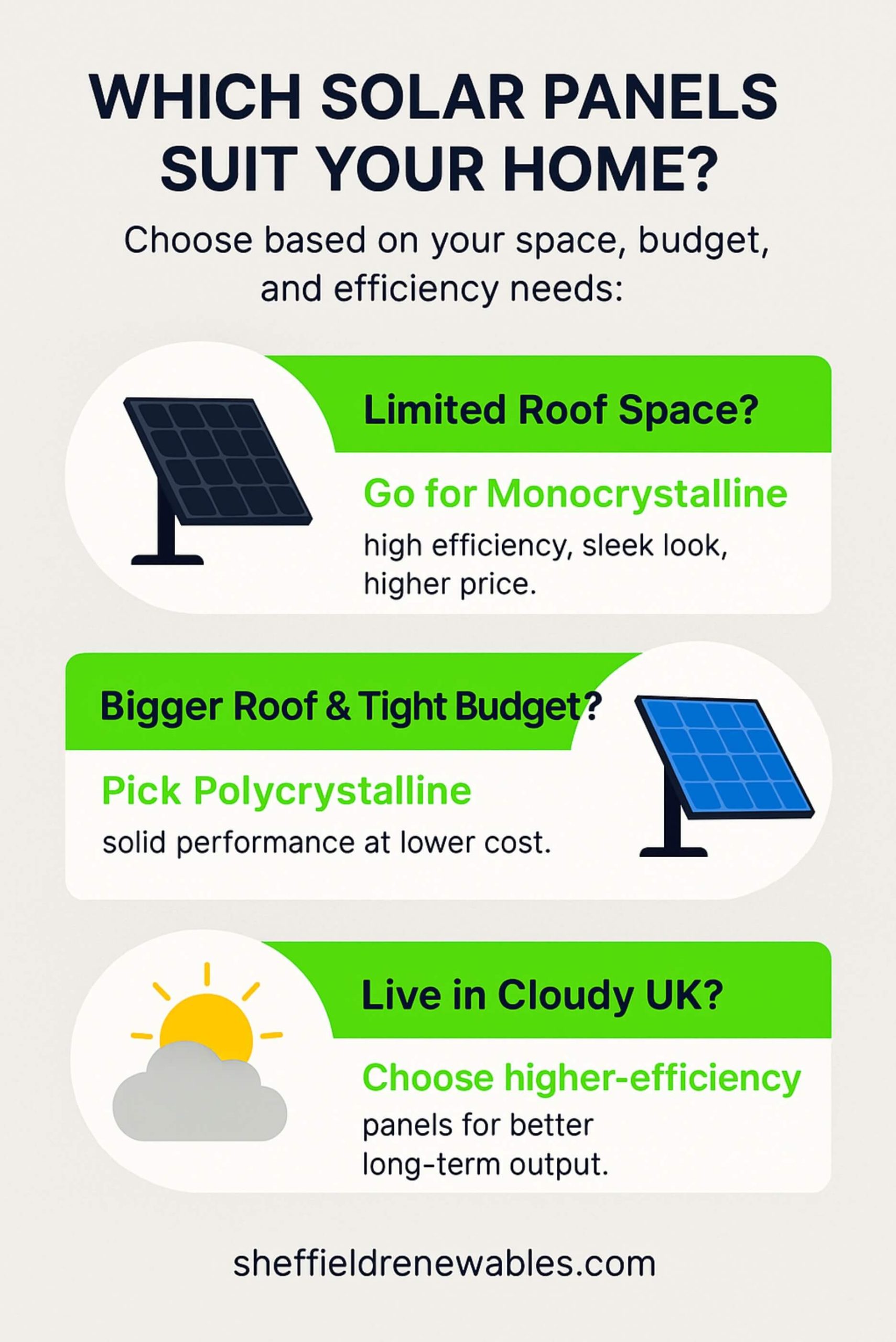
There are three main types of solar panels available in the UK market:
| Panel Type | Efficiency | Cost | Best For |
|---|---|---|---|
| Monocrystalline | 15-22% | Higher | Limited roof space, premium installations |
| Polycrystalline | 13-17% | Mid-range | Budget-conscious with adequate roof space |
| Thin-film | 10-12% | Lower | Flexible applications, lightweight needs |
The size of your system matters too. Domestic installations typically range from 3kWp to 6kWp, with a 4kWp system being common for an average UK home. This would typically include around 10-12 panels covering about 20-25 square metres of roof space.
Read More: Solar Panel Efficiency in the UK
How Much Do Solar Panels Cost?
A typical solar PV system costs around £6,100 for a 3.5kWp installation in the UK. For a 4kWp system, expect to pay £7,000-£8,000 depending on your location and installation complexity.
What Affects the Price?
Several factors influence the final price of your solar installation:
| Factor | Impact on Cost |
|---|---|
| System size | Larger systems cost more but offer better economies of scale |
| Panel type | Monocrystalline panels cost more than polycrystalline or thin-film |
| Roof accessibility | Difficult access requires more scaffolding and labour time |
| Roof type | Flat roofs need mounting frames, increasing costs |
| Additional equipment | Batteries, optimisers, or export limitation devices add cost |
| Installer | Prices vary between companies; always get multiple quotes |
Good News: Solar panel installations are currently zero-rated for VAT until March 31, 2027, after which they'll revert to the reduced rate of 5%. This represents significant savings compared to the standard 20% VAT rate.
How Much Can You Really Save on Electricity Bills?
This is where it gets personal. Your savings depend entirely on how much solar power you generate versus how much you actually use.
Let’s work through an example. A 4 kWp system in England generates approximately 3,820 kWh per year based on official load factor data. At 26.35p per kWh, if you used all that power yourself, you’d save over £1,000 a year. But that’s not realistic.
Most households without a battery self-consume 40% to 60% of their generation. The rest gets exported. If you self-consume 50%, that’s 1,910 kWh you’re not buying from the grid, saving you roughly £503 per year.
The remaining 1,910 kWh gets exported. At a typical SEG rate of 12p per kWh, that’s another £229 income. Total benefit: £732 per year.
People at home during the day do better. Work from home, retired, or have young kids? Your self-consumption could hit 60% or more, pushing bill savings higher. Export income drops slightly, but overall, you’re better off because self-consumed power saves you more than exported power earns.
Read More: Solar Panels vs. Grid Electricity: Which Is Cheaper Over 10–20 Years?
Typical Payback Period
With a £6,100 system saving you £700 to £800 annually, payback sits around 8 to 9 years for well-suited homes. Less ideal scenarios push this to 10 to 13 years.
| Location | Annual Bill Saving | Annual SEG Income | Total Yearly Benefit | Break Even Time |
|---|---|---|---|---|
| London | £185 to £322 | £288 to £370 | £555 to £610 | 10 to 11 years |
| Cardiff | £211 to £351 | £467 to £547 | £758 to £819 | 10 to 11 years |
| Edinburgh | £189 to £259 | £172 to £215 | £403 to £431 | 12 to 13 years |
Here’s something people often overlook: rising electricity prices shorten your payback. If prices increase, your savings increase too. Your system cost stays fixed, but the value of the electricity you generate keeps climbing.
How Does Exporting Electricity Work?
The Smart Export Guarantee (SEG) replaced the older Feed-in Tariff scheme in 2020. Under this scheme, energy suppliers with over 150,000 customers must offer at least one tariff that pays for electricity exported to the grid.
To qualify for SEG payments:
- Your system must be certified under the Microgeneration Certification Scheme (MCS)
- You need a smart meter capable of half-hourly readings
- Your installer must be MCS-certified
SEG rates vary significantly between suppliers, currently ranging from as little as 1p/kWh to as much as 30p/kWh. Some suppliers offer variable rates that track wholesale prices, while others provide flat rates.
It’s worth shopping around for the best export tariff. Your energy supplier doesn’t have to be the same company that pays you for exports, though some suppliers offer better rates to their own customers.
Are Solar Batteries Worth It?
Batteries are tempting. Store daytime solar power and use it in the evening when you actually need it. Makes sense, right?
The economics are trickier than panels alone. A decent solar battery costs £4,500 on average. That’s on top of your panel costs. So now you’re looking at £10,000 plus for the full system.
Batteries increase self-consumption from 40% to 60% up to 70% to 90%. You buy less from the grid and export less. Whether this pays off depends on the gap between your electricity rate and your export rate.
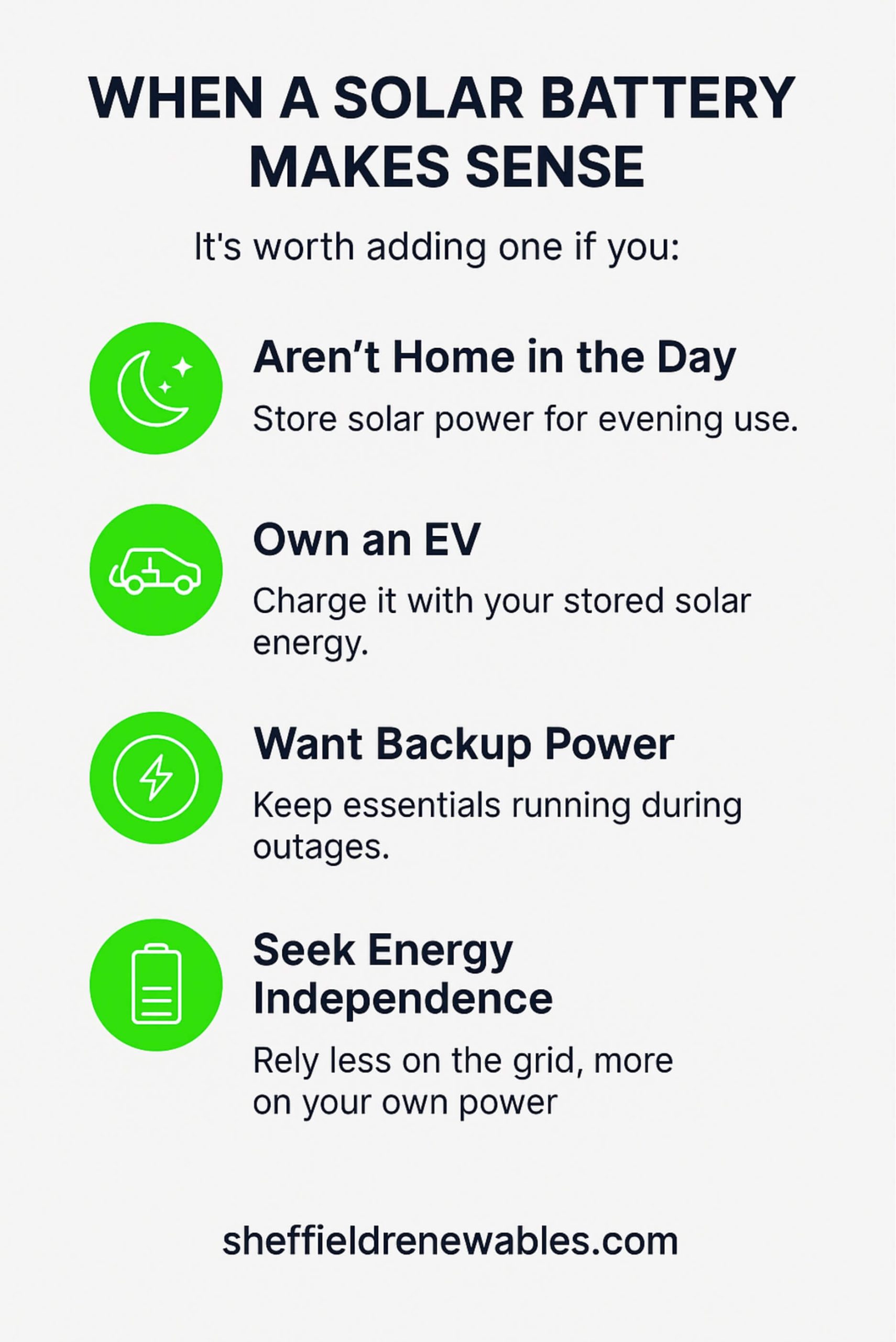
With current technology and prices, adding a battery typically extends your overall payback period by several years. However, as battery prices continue to fall and electricity prices rise, this equation is constantly changing.
Is My Home Suitable for Solar Panels?
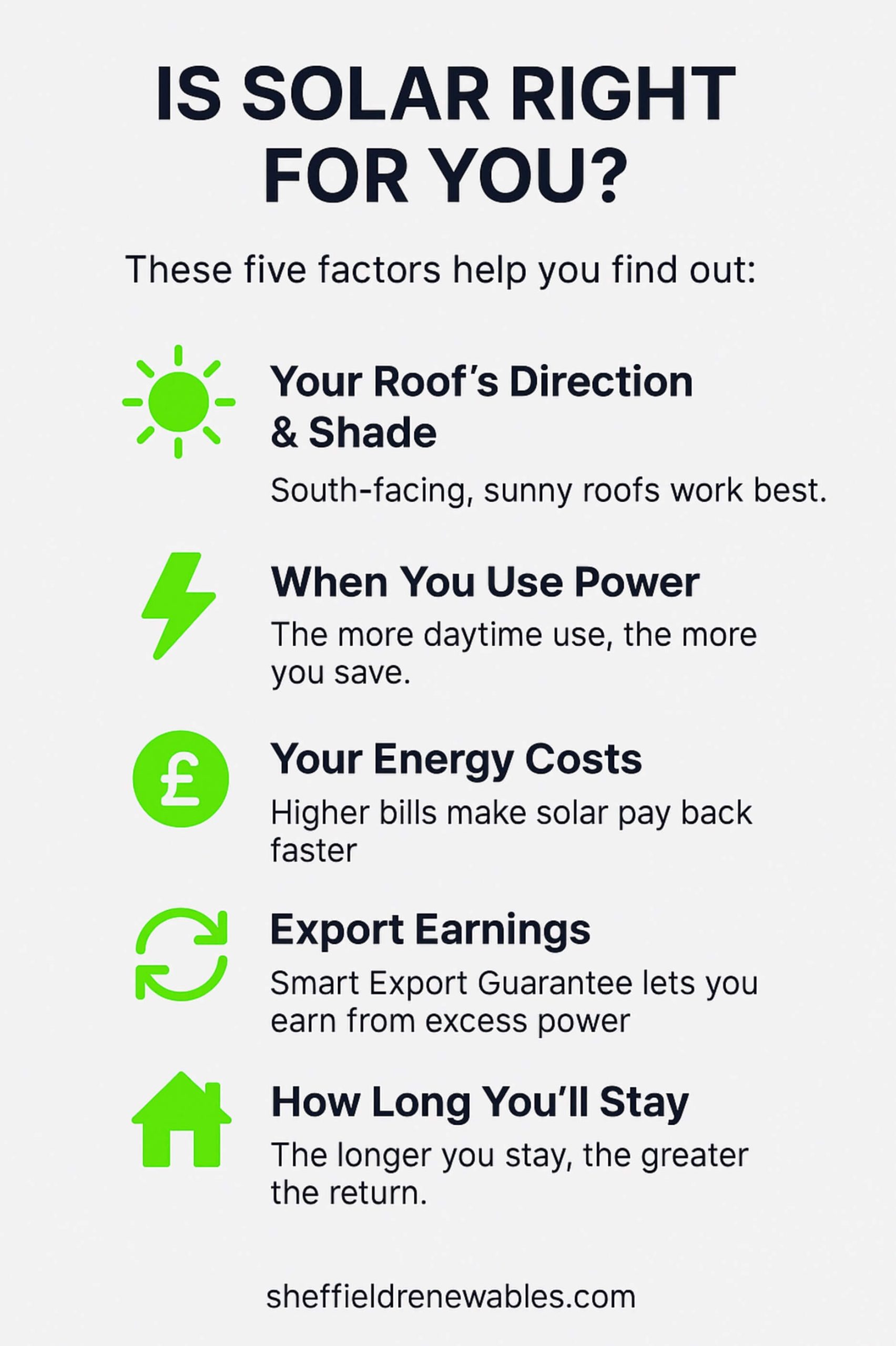
Not all UK homes are ideal for solar panels. Here are the key factors to consider:
- Roof orientation: South-facing roofs receive the most sunlight throughout the day in the UK. East or west-facing roofs can still work well, but might generate 15-20% less electricity. North-facing roofs are generally not recommended unless they have a very shallow pitch.
- Roof pitch: The ideal pitch is around 30-40 degrees for the UK, though solar panels can work on slopes between 10-60 degrees.
- Shading: Even partial shading from trees, chimneys or neighbouring buildings can significantly reduce output. Your roof should ideally be unshaded between 10am and 4pm.
- Roof space and condition: You’ll need approximately 20 square meters of roof space for a typical 4kWp system. Your roof should be in good condition, as panels typically last 25+ years.
- Structural considerations: Your roof must be strong enough to support the additional weight of solar panels (typically around 20kg per panel).
Does Location Matter?
Location within the UK does impact solar panel performance, though perhaps less than you might expect.
Southern England receives more sunlight hours than northern Scotland, resulting in around 10-15% higher generation. However, even in northern regions, solar panels remain viable and can provide good returns.
According to official data, the average load factor for solar panels in England was 10.9% in 2023, which translates to approximately 956 kWh per kWp of installed capacity annually. This varies slightly across regions.
Temperature also plays a role. Contrary to popular belief, solar panels actually perform better in cooler conditions as long as there’s good sunlight. Hot summer days can slightly reduce panel efficiency.
Do I Need Planning Permission or Permits?
Most domestic solar panel installations in the UK qualify as “permitted development” and don’t require formal planning permission. This was further eased by changes in November 2023 that expanded allowances, particularly for flat roofs.
However, you’ll need planning permission if:
- Your property is listed
- You live in a conservation area, and the panels would be installed on a wall/roof facing the road
- The panels would protrude more than 20cm from the roof slope
Building regulations approval is still required even when planning permission isn’t. This ensures structural safety and electrical compliance. Most MCS-certified installers will handle this for you.
Your installer will also need to notify your Distribution Network Operator (DNO) about the installation and arrange appropriate connection agreements, typically following the ENA G98/G99 processes.
Do Solar Panels Increase Home Value?
The impact of solar panels on UK property values remains somewhat mixed. Solar Energy UK’s research suggests homes with solar panels could increase in value by up to 2%. Other sources claim increases of up to 14%.
The National Association of Estate Agents (NAEA Propertymark) takes a more cautious view, suggesting that while interest in sustainable features is growing, the immediate value added may not always offset the installation costs.
Factors that influence the value impact include:
- System age and condition
- Whether the system is owned outright or on a lease/financing agreement
- Quality of installation and components
- Documentation of performance and maintenance
- Aesthetic integration with the property
If you’re planning to sell within the next 5 years, solar panels may not have time to recoup their costs through energy savings alone, so the potential property value increase becomes more important to the investment decision.
Can I Switch Energy Suppliers with Solar Panels?
Yes, absolutely. Solar panels don’t lock you into any particular supplier.
Your electricity supplier and your SEG supplier can be different companies. Many people buy electricity from one supplier while getting SEG payments from another that offers better export rates.
Some suppliers do offer better export rates to customers who also buy their electricity. Octopus Energy is known for competitive export tariffs. British Gas and EDF Energy also tie export rates to supply contracts. Shop around.
When switching, make sure your new supplier knows you have solar panels and want to continue SEG payments. You’ll need your MCS certificate and your system details. They’ll need to verify your smart meter can track exports properly.
Check what happens to your SEG contract if you switch. Some are tied to your supply contract, ending when you leave. Others are separate agreements that continue independently. Read the terms before switching.
Export tariffs change over time. What’s best today might not be best in six months. Review your SEG deal annually, just like you would your supply tariff.
Solar Panel Lifespan and Maintenance
Quality solar panels typically last 25-30 years, with many manufacturers offering 25-year performance warranties. Some newer systems may function effectively for up to 40 years, though with gradually declining efficiency.
Maintenance requirements are minimal:
- Occasional visual inspections for damage or debris
- Cleaning only if noticeably dirty (UK rainfall usually suffices)
- Keeping nearby trees trimmed to prevent shading
Most systems lose efficiency at a rate of about 0.5-0.8% annually, meaning after 25 years, they’ll still produce around 80-85% of their original output.
The inverter, which converts DC electricity from the panels to AC electricity for home use, typically has a shorter lifespan of 10-15 years and costs around £800-£1,500 to replace.
It’s worth checking if your home insurance covers solar panels for damage from storms, fire, or theft. Many policies include them automatically as part of the building, but some may require an additional premium.
Are Solar Panels Recyclable?
Yes, solar panels are recyclable, though the infrastructure in the UK is still developing.
Most components are valuable and recoverable:
- Aluminium frames (100% recyclable)
- Glass (95% recyclable)
- Silicon cells (recoverable)
- Copper wiring (high recovery value)
Under the WEEE (Waste Electrical and Electronic Equipment) Regulations, solar panel manufacturers and importers are responsible for financing the collection, treatment, and environmentally sound disposal of end-of-life panels.
When your panels eventually need replacing, your installer should offer a recycling service. Some manufacturers also have take-back schemes. Avoid sending panels to landfill, as they can contain small amounts of materials that need proper handling.
The EU’s circular economy initiatives are driving improvements in solar recycling technology, with the aim of recovering over 95% of materials in the coming years.
Government Schemes & Grants
While the generous Feed-in Tariff scheme ended in 2019, there are still some financial incentives for UK solar installations:
- Zero VAT Until March 2027: Solar panel installations (and many battery systems) are zero-rated for VAT until March 31, 2027, saving 20% compared to standard VAT rates.
- Smart Export Guarantee (SEG): While not a grant, this scheme ensures you get paid for surplus electricity exported to the grid.
- Energy Company Obligation (ECO4): Some low-income households may qualify for solar panel funding through this scheme, which runs until 2026.
- Home Upgrade Grant: Available in certain local authority areas for low-income households with poor energy efficiency.
- Local Authority Delivery Scheme: Some councils offer solar panel grants to eligible households.
- Regional schemes: Scotland’s Warmer Homes Scotland and the Welsh Government’s Nest scheme occasionally include solar technologies.
Check with your local authority and energy supplier to see if you qualify for any current schemes.
How to Avoid Scams When Installing Solar Panels
The booming solar market has, unfortunately, attracted some unscrupulous operators. Protect yourself by watching for the red flags.
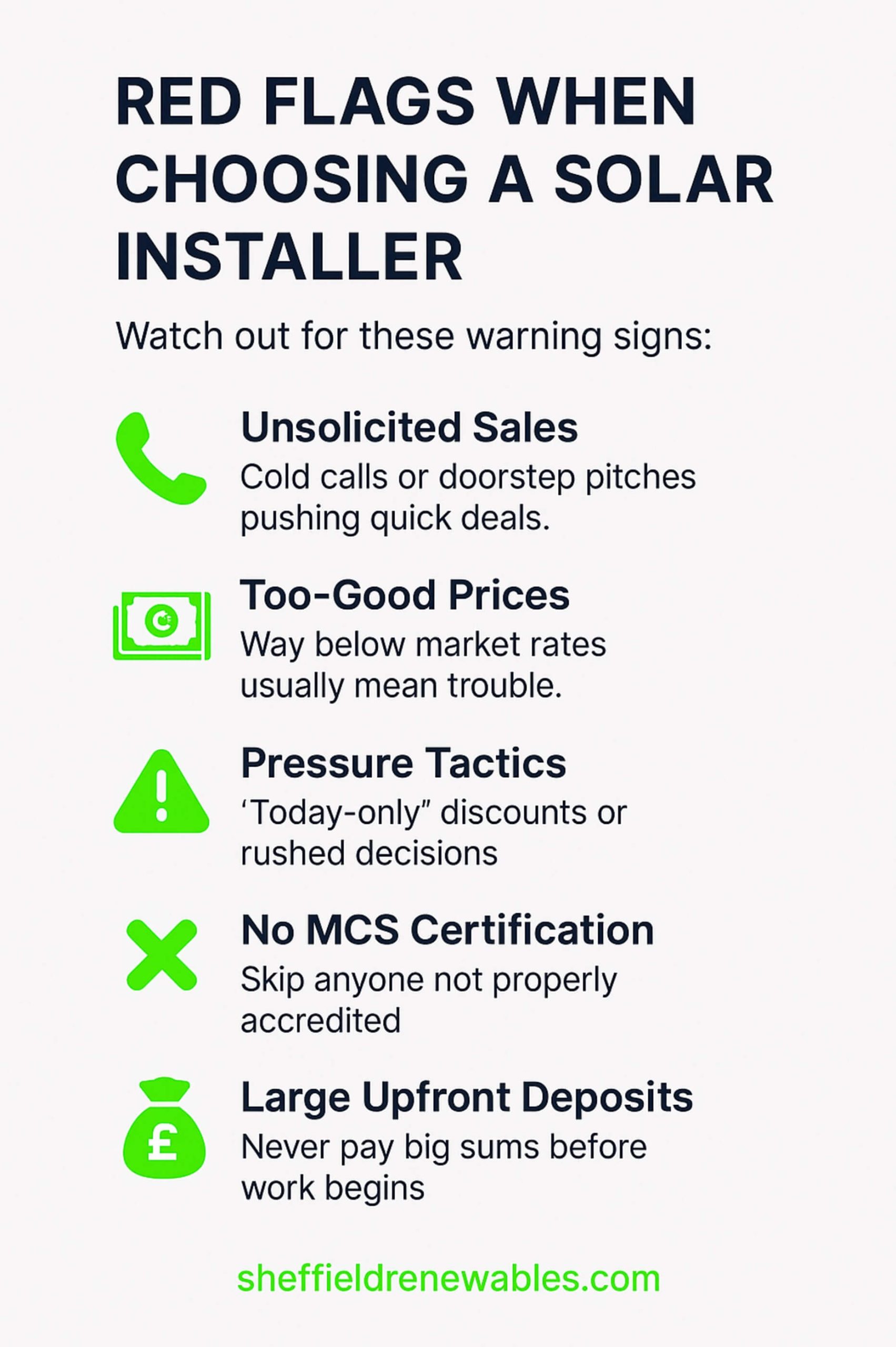
Always verify credentials through the MCS certificate checker and check reviews on independent platforms. Reputable installers will provide detailed quotes, realistic performance estimates, and clear explanations of all warranties and guarantees.
How to Buy Solar Panels
When purchasing solar panels, you have several routes to consider:
Independent Installers
Local MCS-certified installers often provide personalised service and competitive pricing. They typically have good knowledge of local conditions and regulations. Get multiple quotes to compare offerings.
Energy Suppliers
Many major energy companies now offer solar installation services, often with attractive SEG rates for customers who buy panels through them. While potentially more expensive than independent installers, they offer the convenience of bundled services and may provide preferential export rates.
Solar Subscription Models
These “solar as a service” options require little or no upfront cost. Instead, you pay a monthly fee while the provider owns and maintains the system. You benefit from reduced electricity bills, but the provider typically receives the export payments.
When evaluating purchase options, consider:
- Upfront costs versus long-term savings
- Warranty terms and who will honour them
- System ownership and what happens if you move
- Export tariff offers
- Maintenance responsibilities
- Company reputation and longevity
Whichever route you choose, ensure your installer is MCS-certified to qualify for the SEG and provides clear, detailed information about the system, performance estimates, and warranty terms.
Financing Options & Credit Considerations
There are several ways to finance your solar panel installation:
- Cash purchase: The simplest option with the best long-term returns, as you’re not paying interest.
- Personal loan or solar loan: Many banks offer green home improvement loans with competitive rates. Some specialist solar loans allow you to pay back the loan using the savings from your panels.
- Remortgaging: If you’re remortgaging anyway, incorporating solar panel costs can spread the expense over a longer period at mortgage interest rates.
- 0% interest deals: Some installers offer interest-free credit for 2-3 years, but check there’s no premium added to the base price.
- Green mortgages: Certain lenders offer better mortgage rates or additional borrowing capacity for energy efficiency improvements.
When considering finance:
- Calculate the total cost, including interest
- Check for early repayment penalties
- Ensure the monthly payments are less than your projected energy savings
- Confirm who owns the system during the finance period
- Understand the implications if you sell your home
Solar Panel Subscriptions
Solar subscriptions (sometimes called “solar as a service” or “free solar panels”) are an alternative to outright purchase. These models work like renting.
A company installs panels on your roof for little or no upfront cost. You pay monthly, typically £50 to £100, and they maintain the system. You get to use the electricity generated, sometimes at a discount.
The appeal is obvious: solar without a £6,000 bill. The reality is more complicated.
Over a 20-year contract paying £75 monthly, you’ll spend £18,000 compared to buying a system outright for £6,000 to £8,000. You don’t own the panels at the end either.
Advantages include:
- Minimal initial investment
- Immediate bill savings without capital outlay
- Maintenance included
- Potentially lower risk, as performance guarantees are common
Disadvantages include:
- Higher lifetime costs compared to ownership
- Possible complications when selling your home
- Limited control over the system
- You may not benefit from SEG payments
- Potential exit fees for early termination
Always read the contract carefully, particularly regarding what happens if you sell your property, what exit options exist, and who’s responsible for maintenance and repairs.
Tips to Maximise Savings from Solar Panels
Get the most from your solar investment with these practical strategies:
Time your electricity usage wisely. Run appliances like washing machines, dishwashers, and tumble dryers during daylight hours when your panels are generating power.
Consider smart plugs or timers to automate appliance usage during peak generation times.
Install a hot water diverter to use surplus solar electricity for water heating instead of exporting it.
If you have an EV, charge it during sunny periods to use your own free electricity.
Monitor your system’s performance using the provided app or monitoring system. Quick identification of any issues ensures maximum generation.
Compare SEG tariffs regularly as rates change, and switch to better deals when available.
Maintain optimal generation by occasionally checking for and removing debris, and keeping nearby trees trimmed to prevent shading.
Consider adding a battery once you understand your usage patterns, particularly if you use significant electricity in the evenings.
Explore time-of-use tariffs that offer cheaper overnight rates, which can work well with battery storage systems.
Key Calculators to Estimate Payback and Savings
Several online tools can help you estimate the potential return on a solar panel investment:
Government’s Standard Assessment Procedure (SAP) calculations offer standardised performance estimates (though these are more commonly used by assessors than homeowners).
Many solar installers offer their own calculators, though be aware that these may present optimistic scenarios.
When using any calculator, input:
- Your specific postcode (solar irradiance varies by region)
- Accurate roof orientation and pitch
- Realistic system size based on your available roof space
- Current electricity tariff
- Actual household electricity consumption
- Any shading issues
Beware of calculators that predict unrealistically short payback periods or ignore important factors such as inverter replacement costs. While online tools can provide useful estimates, nothing beats a professional on-site survey from a qualified installer. If you want a realistic starting point, you can also use our solar energy calculator to explore typical installation costs and potential savings based on your property details.
Conclusion
If you’re considering solar panels for your UK home, we can help. At Sheffield Renewables, we provide expert guidance, quality installations, and ongoing support for solar PV systems.
Get a free, no-obligation quote today and find out exactly how much you could save with solar panels tailored to your home’s specific needs. Our team of MCS-certified installers will design a system that maximises your energy generation and financial returns while minimising environmental impact.
FAQs
Do solar panels work on cloudy or shaded roofs?
Yes, solar panels work on cloudy days, but generate less electricity. Modern panels can convert diffuse light, but output might be 40-80% lower than on sunny days. Significant shading can reduce output dramatically and should be avoided where possible.
What’s better: fewer south-facing panels or more east/west panels?
It depends on your usage pattern. South-facing panels produce more overall electricity, but east/west installations (split arrays) provide more consistent generation throughout the day, often better matching typical household demand patterns.
How much energy do I lose with a shaded roof?
Even partial shading can reduce output significantly. Depending on panel configuration, shading on just 10% of a panel can reduce its output by 30-40%. Solutions like micro-inverters or power optimisers can help minimise this impact.
Will a battery help if my panels don’t get full sun?
A battery won’t increase generation from partially shaded panels, but it will help you use more of what your system does produce. This can improve the economics if your self-consumption would otherwise be low.
Is solar worth it if I might move home in 3-5 years?
Probably not for financial reasons alone, as the payback period typically exceeds 10 years. However, if you’re confident solar will add value to your property or if environmental benefits are a priority, it might still be worthwhile.
What happens if I switch my electricity supplier?
You can switch electricity suppliers freely with solar panels. Your export (SEG) contract is separate from your import contract, so you can have different suppliers for each, allowing you to get the best deals for both.
How long do panels last, and what happens next?
Most solar panels last 25-30 years, gradually producing less electricity over time. After their useful life, panels can be recycled through specialist facilities, with most components recoverable for reuse in new products.