
Quick Answer: In the UK, solar panels perform best facing south at a 30-35° angle, but southeast/southwest orientations lose only 3-4% efficiency. Even east/west setups produce 65-80% of optimal output, making most roof configurations viable for solar installation.
Most UK homeowners believe their roof isn’t suitable for solar panels because it doesn’t face perfectly south. That’s a costly misconception. While south-facing panels at 30 to 35 degrees do generate the most electricity, even east or west-facing roofs can deliver impressive returns when properly configured. The real key is knowing how orientation, tilt, and UK-specific factors work together to maximise your energy output.
Key Takeaways
- South-facing panels at 30-35° generate maximum energy in the UK, but southeast/southwest orientations still achieve 96-97% efficiency.
- East/west installations produce 65-80% of optimal output and often better match household usage patterns throughout the day.
- Shading impacts solar performance more significantly than orientation; even minimal shade can reduce output dramatically compared to a suboptimal direction.
Why Direction and Angle Matter for UK Solar Panels
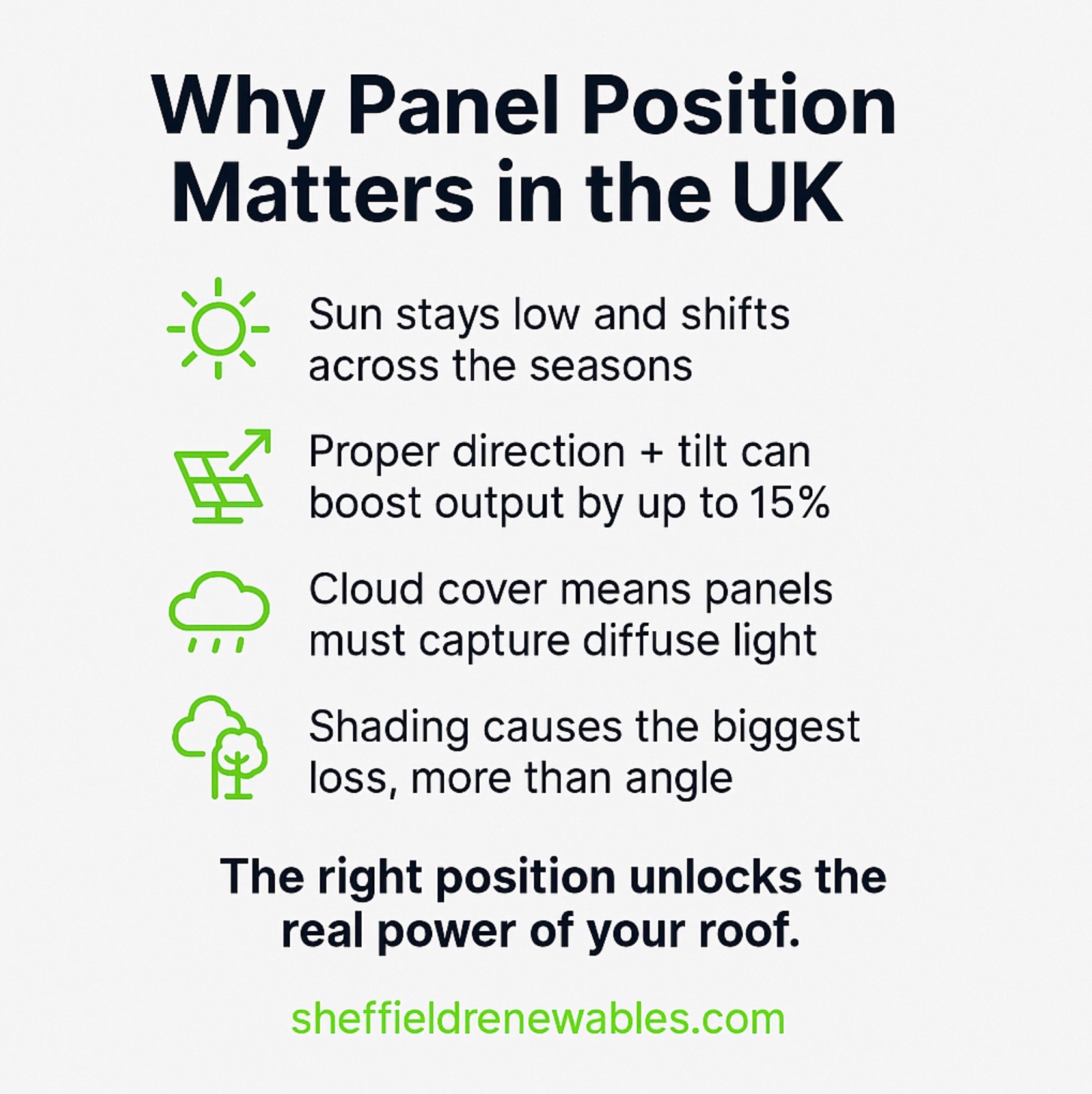
The UK sits between 50° and 60° north of the equator. Unlike countries closer to the equator, our sun never passes directly overhead.
This northern position means the sun follows a lower arc across our sky, especially in winter months when it barely climbs above the horizon.
Well-positioned systems in the UK typically generate 850–1,000 kWh per kWp of installed capacity annually. Getting the direction or angle wrong can reduce output by up to 15%.
That’s before we even consider the effects of shading, which can be far more damaging to overall performance. Our weather patterns also matter. The UK receives significant diffuse light due to cloud cover, which affects how panels should be positioned compared to sunnier climates.
UK seasons bring dramatic changes in daylight hours and sun path. In summer, we enjoy long days with the sun rising early in the northeast and setting late in the northwest. Winter brings short days with the sun rising late in the southeast and setting early in the southwest. These seasonal variations make finding the optimal position a balancing act between summer and winter performance.
Best Direction for Your Solar Panels
South-facing installations deliver the highest annual energy yield in the UK. This isn’t just theory; it’s backed by solid research.
A study of 26 residential systems across Yorkshire found that panels facing almost exactly due south (-1° to be precise) produced the best results. These systems generated between 3,350-4,010 kWh annually from a 4kWp setup.
But what if your roof doesn’t face south?
| Direction | Typical Output Compared to South |
|---|---|
| South (optimal) | 100% |
| Southeast / Southwest (±30°) | 96–97% |
| East / West | 65–80% |
| North | 50–60% |
So, the good news is that panels facing southeast or southwest (within 30° of south) only lose about 3-4% efficiency. Even roofs that are up to 45° off south still perform well enough that other factors like shading often matter more.
Many UK homes have east-west roof orientations. Recent research from the University of Strathclyde shows these setups produce about 64-66% of what identical south-facing systems generate.
East-west systems have a hidden advantage, though. They spread electricity generation throughout the day, often better matching typical household usage patterns. Morning sun hits east-facing panels when you’re making breakfast, while evening sun hits west-facing panels when cooking dinner.
This timing advantage can boost self-consumption rates, making these setups more valuable than raw production numbers suggest.
North-facing roofs are generally the least suitable, producing only 50-60% of what south-facing panels would generate. They’re usually only worth considering if you have exceptionally high electricity costs and no other roof space available.
Optimal Tilt Angles Across the UK
The ideal tilt angle varies slightly based on where you are in the UK:
| Region | Latitude | Optimal Tilt |
|---|---|---|
| South England | 50–52°N | 30–35° |
| Midlands & Northern England | 53–55°N | 35–40° |
| Scotland | 56–58°N | 40–45° |
Most UK homes have roof pitches between 30-45°, putting them naturally close to optimal angles.
Real-world testing in Yorkshire showed the effect of tilt variations. In Hull, three identical 4kWp systems with different tilts produced:
- 42° tilt: 4,053 kWh per year
- 38° tilt: 3,992 kWh per year
- 32° tilt: 3,951 kWh per year
The difference between optimal (42°) and suboptimal (32°) angles amounted to just 102 kWh annually, about 2.5% of total output.
This small difference suggests that most standard UK roof pitches will perform well without modification. The cost of changing your roof angle rarely justifies the small potential gain.
Steeper angles (40-45°) capture more winter sun when it sits lower in the sky. If winter electricity use is high in your home, perhaps for heating, a slightly steeper angle might be beneficial.
Shallower angles (20-30°) favour summer production. For households with higher summer electricity use, perhaps for cooling or with more occupants during school holidays, a flatter installation could work better.
Special Considerations for Different Roof Types
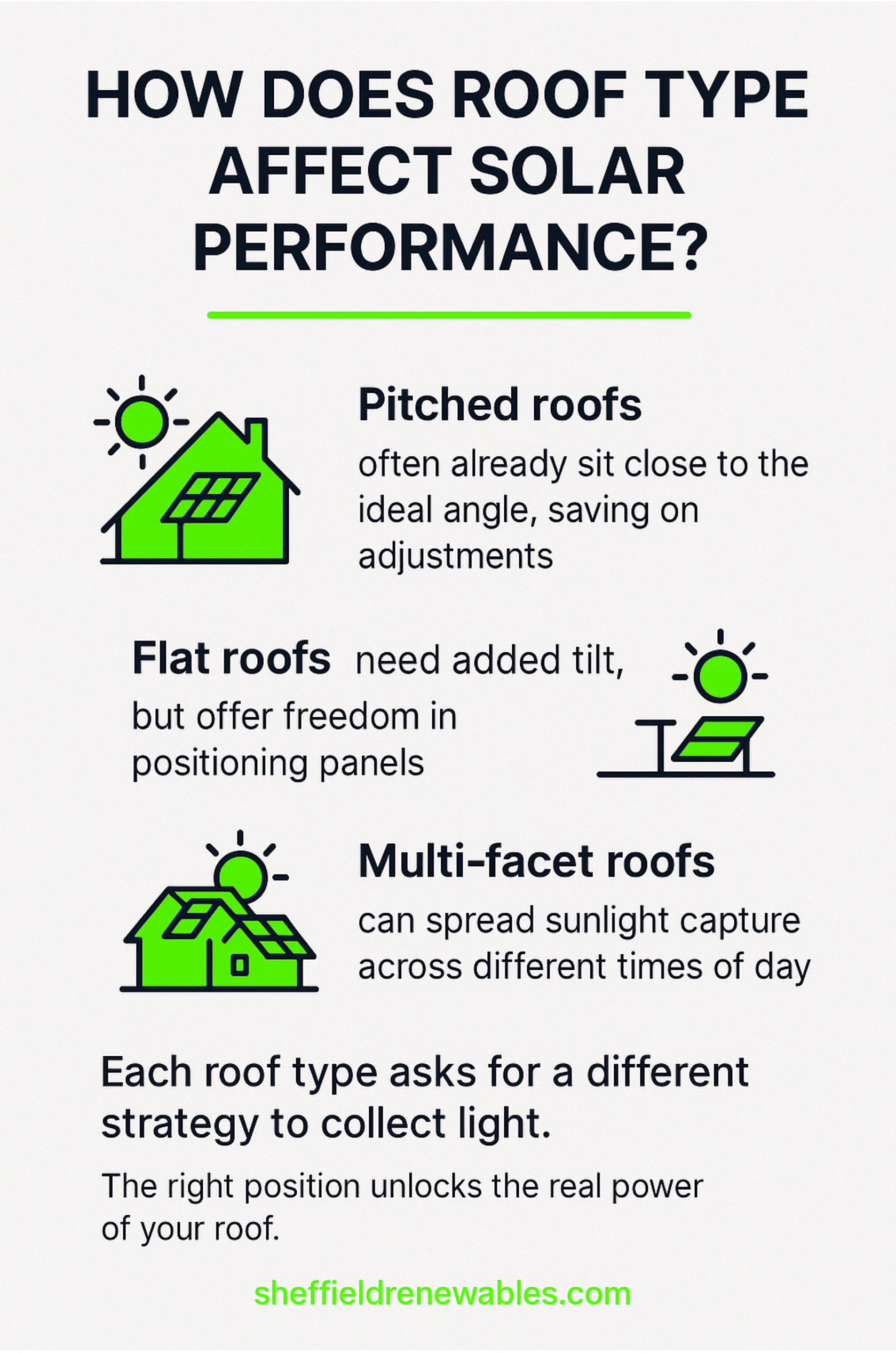
Most UK pitched roofs naturally sit at angles between 30–45°, making them well-suited for solar panels without additional mounting frames.
UK planning rules require that panels on pitched roofs don’t protrude more than 0.2m beyond the roof plane, effectively limiting how much you can adjust panel tilt on existing roofs.
For flat roofs, panels are typically mounted on frames at 10–15° angles. This modest tilt balances energy capture against wind loading and planning height restrictions.
Recent changes to UK planning regulations (December 2023) now allow panels on flat roofs to extend up to 0.6m above the roofline without requiring planning permission. This gives installers more flexibility with flat roof systems.
For homes with multiple roof facets, professional solar installers can design systems that use several roof sections.
- A system spanning south and west roof areas can achieve about 83% of the energy a pure south-facing system would produce.
- This approach also better matches household consumption patterns.
Practical Steps to Optimise Your Solar Setup
Not sure which way your roof faces? Here are some simple methods to check:
- Use a compass app on your smartphone while standing beside your house
- Check Google Maps satellite view of your property
- Look at your property deeds, which often include directional information
Remember that magnetic north differs slightly from true north in the UK. Allow for a few degrees of magnetic declination when using a compass.
Shading is often more important than perfect alignment. A small amount of shade can reduce output by far more than a suboptimal angle. Common shading culprits include:
- Nearby trees (especially those that will grow taller)
- Neighbouring buildings
- Chimneys
- Satellite dishes
- Roof vents
Walk around your property at different times of day to spot potential shading issues. Winter sun casts longer shadows, so what seems clear in summer might be shaded in winter.
Sometimes, the perfect angle and direction must be balanced against available space. A slightly less optimal orientation that accommodates more panels may generate more total energy than a perfectly oriented, smaller system.
Consider battery storage for east or west-facing panels. Batteries allow you to store energy produced during the day for use in the evening, increasing self-consumption rates significantly.
Explore smart export tariffs. Some UK energy companies now offer time-of-use export tariffs that pay more for electricity exported at peak times. This can make west-facing panels more valuable as they generate power later in the day when demand is higher.
Great News: Solar panel installations benefit from 0% VAT until 31 March 2027. After this date, the rate will return to 5%, offering substantial savings compared with the standard 20% VAT.
Conclusion
The science is clear: south-facing panels at 30-35° tilt will maximise your solar generation in most UK locations. However, the real-world message is more forgiving. Your existing roof orientation and pitch are likely already good enough for excellent performance without costly modifications.
Remember that shading, system quality, and installation expertise often impact performance more than small deviations from “perfect” positioning. Ready to find out exactly how much solar potential your roof has? Contact our expert solar assessment team for a free, no-obligation property evaluation and let the sunshine pay your bills.
FAQ
Can solar panels work effectively if not facing south?
Yes, panels facing southeast or southwest typically lose only 3-5% efficiency compared to south-facing installations. East and west-facing panels still generate about 65-80% of a south-facing system’s output, making them viable options, especially with battery storage.
Does the angle of solar panels matter during the winter months?
Yes, steeper angles (40-45°) perform better in winter as they capture more of the low winter sun. If winter generation is particularly important to you, consider a slightly steeper tilt than the standard 30-35° if your roof allows it.
Should I install solar panels on my east/west-facing roof?
Absolutely. East/west installations still generate substantial power and offer the advantage of spreading generation throughout the day. This often better matches household consumption patterns and can improve self-consumption rates.
How much efficiency do I lose with a non-optimal panel angle?
Very little. Research shows that even a 10° deviation from the optimal tilt angle typically reduces annual yield by only 2-4%. Most standard UK roof pitches will perform quite well without modification.
What’s more important: the right direction or avoiding shade?
Avoiding shade is far more critical. Even minimal shading can reduce panel output dramatically, whereas a suboptimal direction might reduce efficiency by just 5-10%. Always prioritise unshaded areas over perfect orientation.