

Quick Answer: In 2026, most residential solar panels installed in the UK operate at around 15–22% efficiency, with premium monocrystalline panels reaching approximately 23–24% under standard laboratory conditions. Despite the UK’s variable and often cloudy climate, modern solar technology delivers reliable electricity generation across all regions.
Key Takeaways
- Solar panels installed in the UK in 2026 typically operate at 15–22% efficiency, with premium panels reaching around 23–24% under ideal conditions.
- Modern solar systems generate reliable electricity across the UK, including in cloudy regions, as panels produce power from daylight rather than direct sunshine alone.
- A typical 4 kWp domestic system produces around 3,100–4,200 kWh per year, depending on location, roof orientation, and shading.
- The UK’s cooler climate helps maintain performance, as solar panels lose efficiency at higher temperatures.
- Most well-designed UK installations achieve 80–90% real-world performance compared with laboratory ratings.
- Solar panels degrade slowly over time, typically retaining around 80% or more of their original output after 25 years.
Why Solar Panel Efficiency Matters in the UK
Solar panel efficiency describes how much of the sunlight hitting a panel is converted into electricity. Higher efficiency means:
- More electricity produced per square metre of roof space
- Better performance on limited roof area
- Faster returns on investment through higher energy output
Unlike a decade ago when typical panels achieved around 12–15% efficiency, modern technology has raised that baseline significantly.
1. Module Efficiency
This measures how effectively a panel converts sunlight into electricity, expressed as a percentage.
Most residential panels sold in the UK fall between 15% and 22% efficiency. Higher-end monocrystalline and advanced technologies can reach around 23–24% or more under ideal conditions.
2. System (Real-World) Output
Rated efficiency rarely equals what you get at home. Losses occur due to:
- Inverter conversion
- Wiring and shading
- Temperature variation
- Soiling and panel orientation
This real-world performance is typically expressed as a performance ratio. For well-designed UK systems, this usually sits around 80–90% of theoretical maximum output.
3. Annual Energy Yield
Energy yield is the actual electricity generated per installed capacity, influenced by climate, daylight hours, and system design.
In the UK, annual yields typically range from 712 to 1,124 kWh per installed kWp, depending on location and conditions.
Average Solar Panel Efficiency in the UK (2026)
Most solar panels installed on UK homes convert between 15% and 22% of sunlight into electricity. Premium monocrystalline panels now routinely achieve 20-23% efficiency, with top-tier models pushing past 24%.
This represents a clear improvement over older technology:
- Around 2010: typically 12–15% efficiency
- Today: commonly 18–21%, with premium models exceeding 22%
These improvements mean modern systems can achieve higher outputs using fewer panels, making solar suitable for a wider range of properties.
How Much Electricity Do UK Solar Panels Produce?
Actual electricity generation depends on efficiency, roof orientation, pitch, shading, and location.
Typical UK annual yields per installed kilowatt (kWp) are:
- Southern England: up to ~1,050–1,100 kWh
- Midlands & Northern England: ~900–1,000 kWh
- Scotland: ~850–900 kWh
A typical 4 kWp domestic system produces approximately:
- 3,600–4,200 kWh per year in southern areas
- 3,100–3,600 kWh per year in northern regions and Scotland
This is enough to cover a substantial portion of an average household’s annual electricity use.
| System Size | Estimated Annual Output | Notes |
|---|---|---|
| 2 kW | ~1,700 kWh | Suitable for smaller homes |
| 3 kW | ~2,500–2,700 kWh | Good mid-size system |
| 4 kW | ~3,400 kWh | Typical UK home system |
| 5 kW+ | ~4,200 kWh+ | Larger homes or higher usage |
Even in cloudy conditions, solar panels continue generating electricity because they rely on daylight rather than direct sunshine alone.
Types of Solar Panels Available in the UK
There are three main types of solar panels commonly used in the UK, each offering different efficiency levels and suitability depending on roof space, budget, and installation requirements.
Monocrystalline Solar Panels
Monocrystalline solar panels are the most efficient option currently available for UK homes. They typically operate within the 18–24% efficiency range, meaning they generate more electricity from a smaller surface area. This makes them particularly well suited to properties with limited roof space or higher electricity demands. Their higher efficiency also allows for better performance in lower light conditions, which is beneficial in the UK climate.
Polycrystalline Solar Panels
Polycrystalline solar panels offer a more cost-effective alternative, usually achieving efficiencies of around 15–20%. While they require slightly more roof space to produce the same output as monocrystalline panels, they remain a practical option for homes with ample roof area where upfront cost is a key consideration.
Thin Film Solar Panels
Thin-film solar panels have lower overall efficiency, typically falling between 10–20%, and therefore need a larger surface area to achieve comparable output. Although they are less common on UK homes, they are sometimes used in specialist applications where flexibility, lower weight, or integration with certain building materials is required.
In general, higher-efficiency panels produce more electricity per square metre, making them the preferred choice for smaller roofs or where maximising output is a priority. Where space is less restricted, lower-efficiency options can still deliver strong overall performance when correctly sized and installed.
What Factors Affect Solar Efficiency in the UK?
Weather and Climate Impact
British weather has a significant but not overwhelming impact on solar performance. Southern England receives around 1,000-1,100 kWh/m² of solar radiation annually, while Scotland gets about 850 kWh/m².
Surprisingly, panels often perform better in cooler UK temperatures than in hotter climates. Most solar panels lose 0.35-0.40% efficiency for each degree above 25°C. Our moderate climate helps maintain efficiency even during the summer months.
Contrary to popular belief, solar panels still generate electricity on cloudy days. They produce about 10-25% of their rated output during heavy cloud cover.
Shade, Orientation, and Roof Angle
Shade is kryptonite to solar panel efficiency. Even partial shading of one panel can significantly reduce an entire system’s output if you use string inverters without optimisers.
The ideal orientation in the UK is due south, but southeast or southwest-facing panels only lose about 5-10% efficiency.
The optimal roof angle for year-round performance is 30-40° in the UK. If you want to maximise winter generation, aim for steeper angles around 40-45°.
Inverter and System Type
Your choice of inverter dramatically affects system performance. String inverters are common but vulnerable to the “weakest link” problem, where one underperforming panel reduces the output of all panels in the string.
Microinverters or power optimisers can increase system efficiency by 5-25% in partially shaded conditions by allowing each panel to operate independently.
Modern hybrid inverters with battery storage don’t necessarily increase efficiency, but they do improve overall energy utilisation by storing excess daytime generation for evening use.
Age and Maintenance of Panels
Solar panels gradually lose efficiency over time. Field studies across the UK show monocrystalline panels degrade by about 0.8% annually, meaning a 25-year-old system will still produce around 80% of its original output.
Regular maintenance makes a difference. Simply cleaning panels can improve output by 5-10% if they’ve accumulated significant dirt or bird droppings.
How to Improve Solar Efficiency at Home
Several practical steps can boost your solar system’s performance.
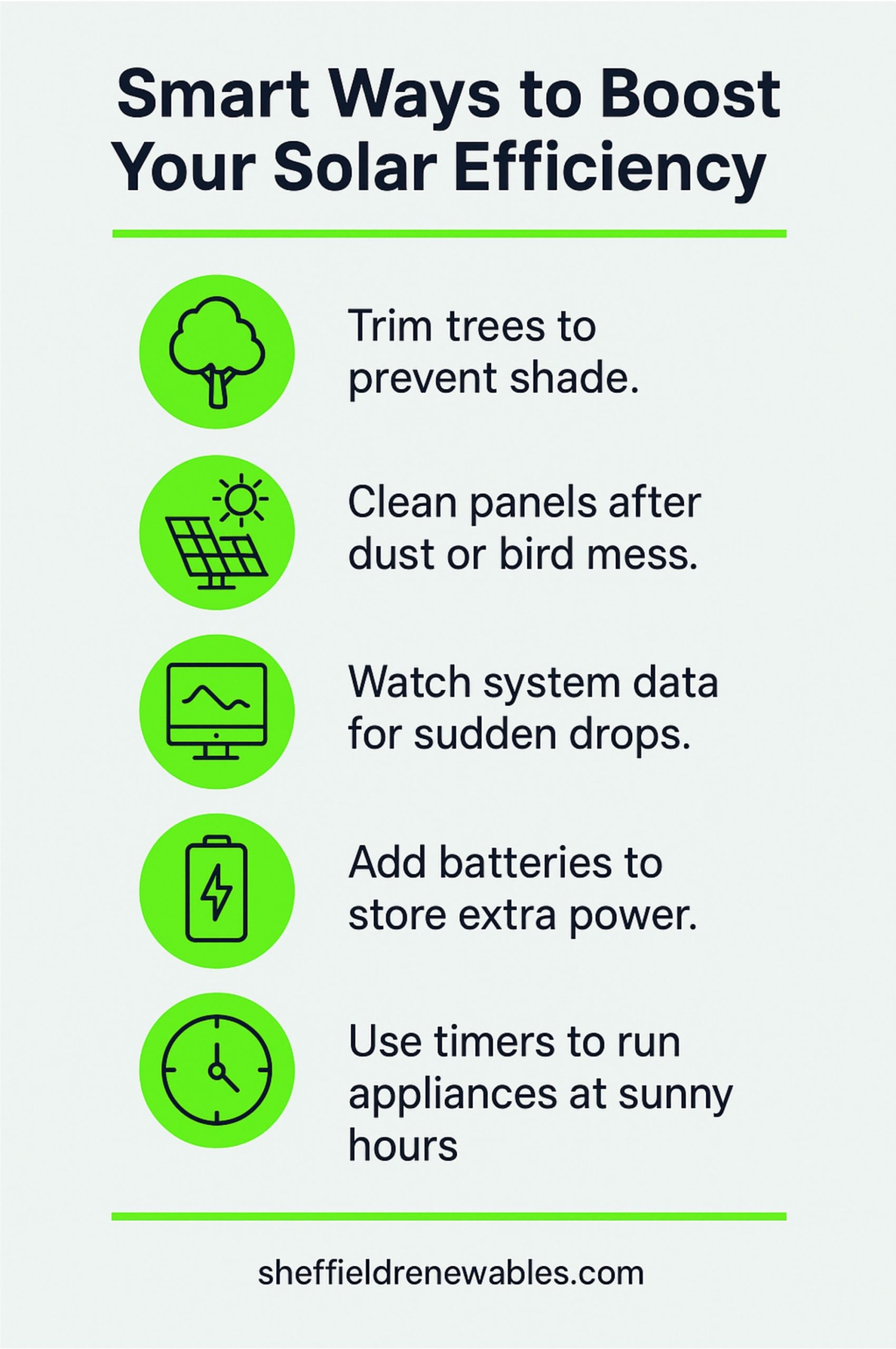
The last point often gets overlooked, but it can make a massive difference to your energy bills. Running your dishwasher at noon rather than 7 pm means using your free solar electricity instead of expensive grid power.
Are High-Efficiency Panels Worth It?
High-efficiency panels make financial sense when roof space is limited. If you have plenty of roof area, standard efficiency panels often provide better value.
Premium 22-24% efficient panels typically cost 15-25% more than standard 18-20% panels. This premium is worth paying if:
- Roof space is limited
- You want to maximise output per square metre
- You plan to increase electricity use in the future (e.g. EV charging or heat pumps)
For most UK homes with adequate roof space, the sweet spot remains panels in the 19-21% efficiency range, balancing performance and cost.
System Efficiency vs Panel Efficiency
Panel efficiency is measured under laboratory conditions. Real-world systems experience additional losses from:
- Inverter conversion
- Electrical cabling
- Orientation and shading
- Dust and natural soiling
A well-designed UK solar installation typically achieves a performance ratio of around 80–90%, meaning most of the panel’s theoretical output is delivered in practice.
Great News: Modern systems with quality components installed by professionals typically achieve performance ratios closer to 85-90%, narrowing this gap considerably.
Solar Panel Degradation Over Time
Solar panels gradually lose efficiency as they age:
- Typical degradation: ~0.5–0.8% per year
- After 25 years: usually around 80% or more of original output
Modern panels are designed for long service lives and supported by long-term performance guarantees.
Solar Power in the UK Today
Solar energy continues to expand across the UK, supplying electricity to millions of homes each year. Improvements in efficiency, falling equipment costs, and better system design have made solar a reliable and increasingly mainstream energy solution — even in regions with lower sunlight levels.
Conclusion
Solar panels in the UK in 2026 are efficient, reliable, and well-suited to the national climate. With typical efficiencies of 15–22%, strong real-world energy yields, and long operational lifespans, solar remains one of the most effective ways for UK households to reduce electricity bills and carbon emissions.
Your home’s specific conditions greatly affect potential performance. We provide comprehensive site assessments to calculate your roof’s solar potential and expected returns. Our expert team can design a system that maximises efficiency for your unique situation. Contact us today for a no-obligation assessment and discover how much you could save with solar power.
FAQs
Do solar panels work in cloudy weather?
Yes. Panels generate 10-25% of their maximum output during heavy cloud cover and up to 80% in light overcast conditions. Annual UK yield calculations already account for typical cloud patterns.
How much efficiency is lost in winter?
Winter output typically drops to 20-30% of summer production due to shorter days, lower sun angle, and increased cloud cover. However, cooler temperatures slightly improve panel efficiency on clear winter days.
Will a battery improve savings if panels lack full sun?
Batteries don’t improve panel efficiency but can increase financial savings by storing excess generation for use during evening peak rates (4-7 pm), when electricity costs up to three times more than during daylight hours.
Is it better to buy fewer high-efficiency panels or more budget ones?
If roof space isn’t limited, more standard-efficiency panels usually deliver better value. High-efficiency panels make sense for smaller roofs where maximising output per square meter is essential.
Do solar panels lose efficiency over time?
Yes. UK field studies show monocrystalline panels typically degrade by about 0.8% annually. After 25 years, expect around 80% of the original output. Premium panels often have better degradation guarantees (0.5% per year).