

UK solar panels typically pay for themselves in 8-12 years through energy bill savings and export payments. With systems lasting 25+ years, homeowners enjoy 13-17 years of profit after breaking even. Current installation costs average £6,500 for a standard system.
Key Takeaways
- Solar panel costs have decreased while energy prices have risen, making the average UK payback period 8-12 years with systems lasting 25+ years.
- System size matters: a typical 3.5kW system costs around £6,500 and saves approximately £625 annually through reduced bills and export payments.
- Adding battery storage increases initial costs but boosts self-consumption from 40-50% to 70-80%, providing greater energy independence and protection against price rises.
What Is Solar Panel Payback?
Solar panel payback is simply the time it takes for your energy savings and income from exported electricity to equal your initial installation cost. It’s the point where your solar investment breaks even.
For example, if your system costs £6,500 and saves you £650 per year, the payback period would be 10 years. After this point, you’re essentially generating free electricity for the remaining life of the system, typically 25+ years.
This figure is what most homeowners want to know before committing to solar panels. Will it take 5 years to break even? 10 years? 15? The answer varies based on several factors.
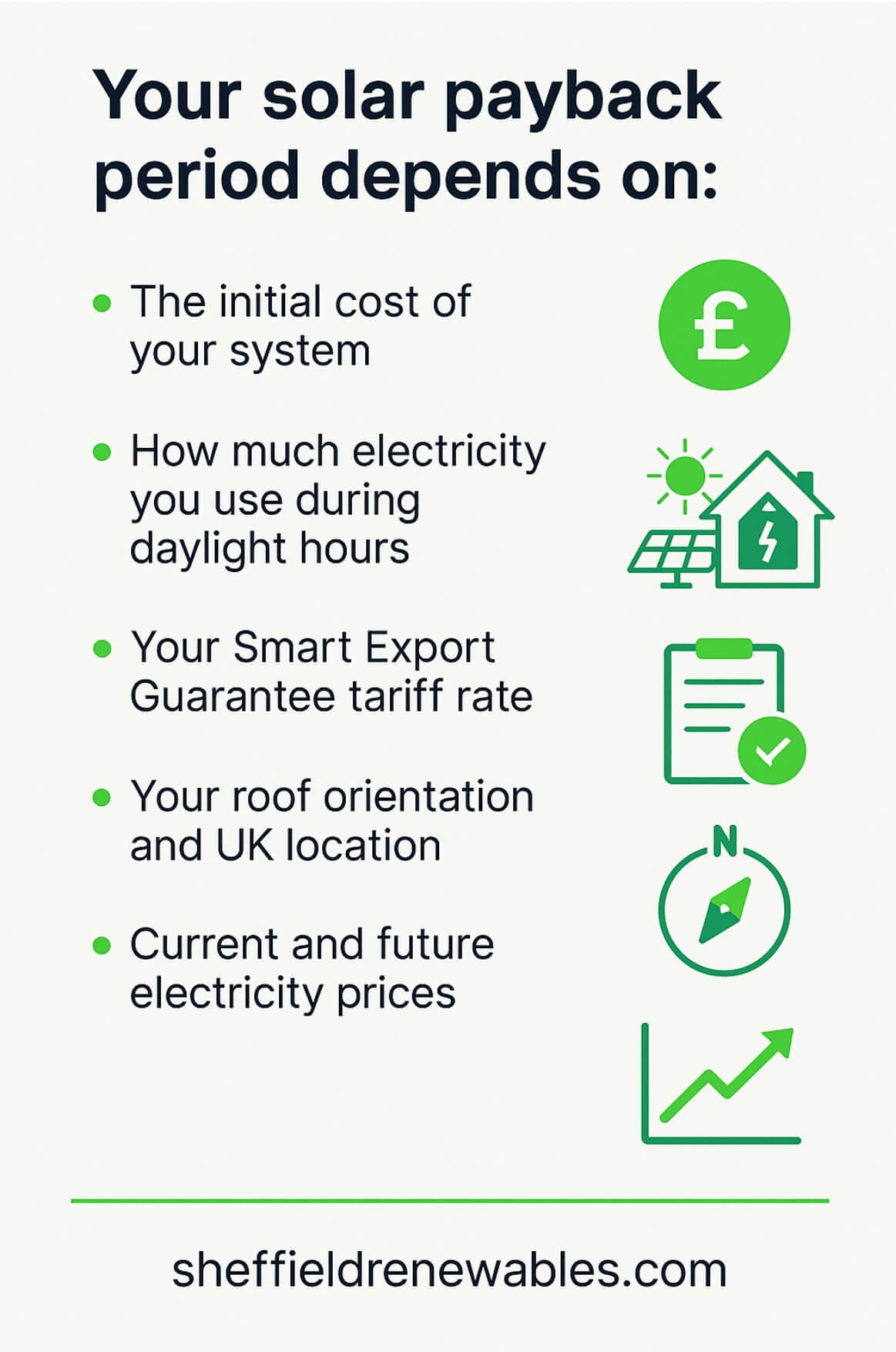
A south-facing roof in a sunny area like Cornwall with high daytime electricity usage will see a faster payback than a partially shaded roof in northern Scotland with minimal daytime energy consumption, as higher solar panel efficiency and better solar exposure directly improve overall system performance.
Solar Panel Installation Costs Today
The price of solar panel systems has fallen significantly over the past decade. According to the latest government data from DESNZ, a typical 3.5kW domestic rooftop installation costs around £6,500 in 2024/25, down from approximately £9,000 in 2013/14 (adjusted for inflation).
Current average system costs by size:
| System Size | Typical Cost Range |
|---|---|
| 3kW system | £5,000–£6,000 |
| 4kW system | £6,500–£8,000 |
| 6kW system | £9,000–£12,000 |
Adding battery storage will increase your initial investment by £3,000–£6,000, depending on capacity and features.
Good news: Solar panel installations currently benefit from 0% VAT until March 31, 2027, after which it will return to 5%. This temporary tax break makes now an excellent time to consider solar panel installation.
How Solar Panels Save You Money
Solar panels generate savings through three main channels:
First, they reduce your electricity bills by allowing you to use free solar energy instead of buying from the grid. Government estimates suggest a typical 3.5kW system saves around £500 annually on electricity bills.
Second, the Smart Export Guarantee (SEG) pays you for surplus electricity exported to the grid. The latest Ofgem data shows an average rate of 8.9p/kWh, with tariffs ranging from 1p to 27p/kWh across 42 different offers.
Third, as energy prices rise, so do your savings. Each price cap increase means greater value from every kilowatt-hour your panels produce.
Here is a simple example:
- Annual bill savings: £500 (typical for a 3.5kW system)
- Annual SEG income (exporting 1,400kWh at 8.9p/kWh): £125
- Total annual benefit: £625
With a system cost of £6,500, this gives a simple payback period of about 10.4 years.
Select your house size to see an estimated cost and savings with solar panels.
House size:
Battery:
Include battery (5.2kWh)
Battery storage helps you use more of your solar energy and increase savings over time.
 Cost & savings
Costs and savings depend on house size, system size, solar generation, optional battery storage, and typical energy usage. This estimate shows how we calculate expected costs and savings.
-
This solar system could cost:
£7,016 -
Estimated yearly electricity bill savings:
£630 -
Estimated payback period:
11 years
 With finance
Spread the cost of your solar system with finance from our approved lending partners. All finance is subject to eligibility, approval, and applicable terms and conditions.
-
Over 5 years
£138 per month
-
Over 10 years
£86 per month
-
Over 20 years
£62 per month
Example finance illustration: Total order value: £10000. Loan duration: 10 years. Upfront deposit: £500. Total amount of credit: £9500. Representative APR: 9.9%. Rate of interest: 9.5% (fixed). Total cost of credit: £5262.4. Total amount payable: £15262.4. Monthly payment: £123.02.
Payback Examples for UK Homes
Payback periods vary significantly depending on your home type, energy usage patterns, and system size. Let’s look at some typical scenarios:
Small Terraced House – 3kW System
For a smaller property with a 3kW system costing around £5,500:
- Without battery: Annual savings of approximately £400 + SEG income of £115 = £515 total benefit, giving a payback period of about 10.7 years
- With battery (additional £3,500): Higher self-consumption leading to £600 annual savings + reduced SEG income of £60 = £660 total benefit, extending payback to around 13.6 years
Semi-Detached – 4kW System
For a medium-sized property with a 4kW system costing £7,000:
- Without battery: Annual savings of £530 + SEG income of £150 = £680 total benefit, giving a payback period of about 10.3 years
- With battery (additional £4,000): Annual savings increase to £800 + SEG income drops to £80 = £880 total benefit, giving a payback of around 12.5 years
Detached Home – 6kW System
For a larger property with a 6kW system costing £10,000:
- Without battery: Annual savings of £800 + SEG income of £220 = £1,020 total benefit, giving a payback period of about 9.8 years
- With battery (additional £5,000): Annual savings increase to £1,200 + SEG income drops to £110 = £1,310 total benefit, giving a payback of around 11.5 years
| House Type | System Size | Install Cost | Annual Savings | SEG Income | Total Benefit | Payback Years |
|---|---|---|---|---|---|---|
| Terraced | 3kW | £5,500 | £400 | £115 | £515 | 10.7 |
| Terraced + Battery | 3kW | £9,000 | £600 | £60 | £660 | 13.6 |
| Semi | 4kW | £7,000 | £530 | £150 | £680 | 10.3 |
| Semi + Battery | 4kW | £11,000 | £800 | £80 | £880 | 12.5 |
| Detached | 6kW | £10,000 | £800 | £220 | £1,020 | 9.8 |
| Detached + Battery | 6kW | £15,000 | £1,200 | £110 | £1,310 | 11.5 |
Regional variations can significantly impact these figures. For example, data shows that areas like Suffolk and Southampton often see faster payback times (as low as 5.2-5.4 years for systems without batteries) compared to other regions.
Battery Storage Impact on Solar ROI
Battery storage systems are game-changers for solar power. Without a battery, you’ll typically use 40-50% of the electricity you generate. With a battery, this can jump to 70-80% or higher.
The catch? Batteries add £3,000-£6,000 to your upfront costs. This often extends the overall payback period unless you can access premium “bundled” export tariffs that require battery systems.
According to Ofgem data, many of the highest SEG rates (up to 27p/kWh) come with specific suppliers or battery systems. These premium rates can dramatically improve the financial case for batteries if you qualify.
Batteries also provide benefits beyond simple payback calculations:
- Keep the lights on during power cuts
- Greater energy independence
- Protection against future energy price rises
Maximising Your Solar Investment
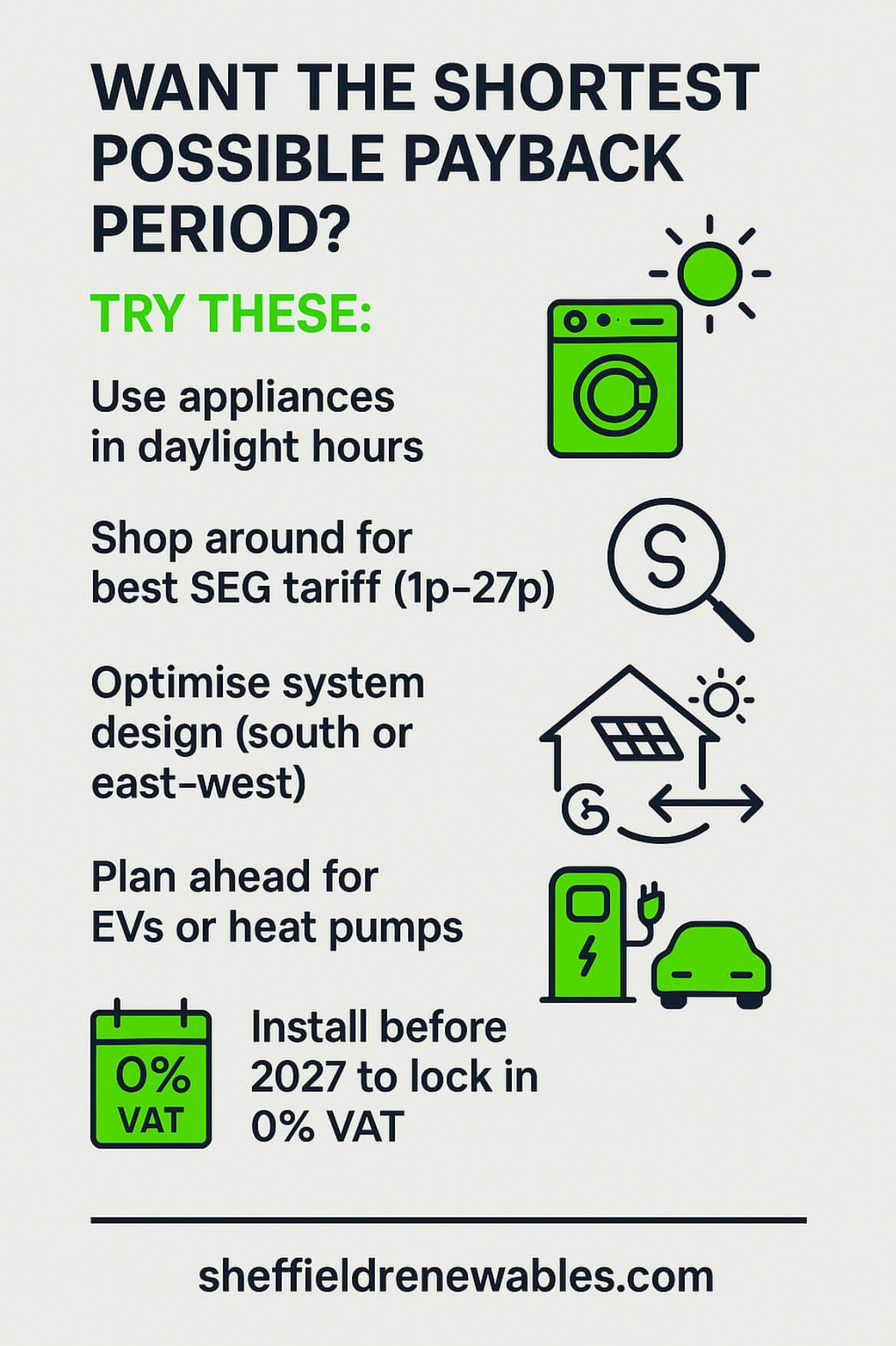
Getting the fastest return on your solar panels isn’t just about installation costs; it’s also about how you use and optimise your system. Simple choices can significantly shorten your payback period.
Benefits Beyond Financial Payback
The financial return isn’t the only reason to invest in solar panels:
- Increased property value – Studies show that homes with solar panels can command higher prices, with the average increase in England estimated at around £16,000.
- Energy independence – Generating your own electricity reduces your exposure to rising energy costs and supply issues.
- Long-term reliability – Solar panels typically come with 25-year performance warranties and require minimal maintenance.
- Environmental benefits – A typical solar panel system can save around 1.6 tonnes of carbon per year compared to grid electricity.
Is Solar Worth It? The Verdict
With typical system costs around £6,500, annual savings of approximately £500, and SEG payments averaging around £125 at current rates, most UK homeowners can expect to break even on their solar investment within 8-12 years.
Given that solar panels typically perform well for 25+ years, this means most systems will provide 13–17 years of pure profit after paying for themselves. When homeowners ask are solar panels worth it, these long-term returns, combined with protection against future energy price rises, increased property values, and clear environmental benefits, show why solar is an attractive proposition for many UK households.
Ready to discover your own solar payback period? Contact us today for a personalised assessment of your property and a no-obligation quote. Our expert team will help you understand exactly how solar could work for your home and budget.
FAQs on Solar Panel Payback in the UK
How long do solar panels typically take to pay for themselves in the UK?
Most UK homeowners can expect a payback period of 8-12 years, with some regions seeing faster returns of 5-6 years depending on system size, energy usage patterns, and SEG rates.
Does adding a battery make financial sense for most homes?
Batteries generally extend payback periods slightly but increase energy independence. They make the most financial sense for households with high evening electricity usage or those able to access premium “bundled” SEG tariffs.
Will solar panels increase my property value?
Yes, research indicates that solar panels can increase property values by approximately 4-6% in the UK, with the benefit being higher in areas with stronger housing markets.
How reliable are payback period estimates?
Payback calculations depend on current energy prices, SEG rates, and usage patterns. Quarterly price cap adjustments and changing SEG offers can alter payback periods by 1-2 years, so regular recalculation is advisable.
What happens after the payback period is reached?
After the payback period, your solar panel system continues to generate free electricity and SEG income. With systems typically lasting 25+ years, most owners enjoy 15+ years of pure profit after breaking even.
How do regional differences affect solar panel ROI in the UK?
Southern regions generally see faster payback due to higher solar irradiation, but local installation costs and energy usage patterns can sometimes make northern regions competitive too. Areas like Suffolk and Southampton often see some of the fastest payback times.